The 1865 Discovery of New Zealand's Only White Heron Breeding Colony
Updated: Sep 11
Gerhard Mueller's 1865 Discovery
The location of New Zealand's only Kōtuku (White Heron) breeding colony remained largely unknown to Europeans until the mid-19th century.
Following an expedition along the Waitangiroto River on 30 December 1865, a young surveyor Gerhard Mueller wrote the earliest known European record of the colony in a letter to his wife, "Bannie", who was living in Invercargill.
His letter provides a fascinating first-hand description of the Kōtuku colony and the surrounding rainforest.
Gerhard Mueller’s Account of the Kōtuku Colony
The following extract from the letter is recorded in the book:
MY DEAR BANNIE – Gerhard Mueller's Letters from the West Coast 1865–6
(published in 1958)
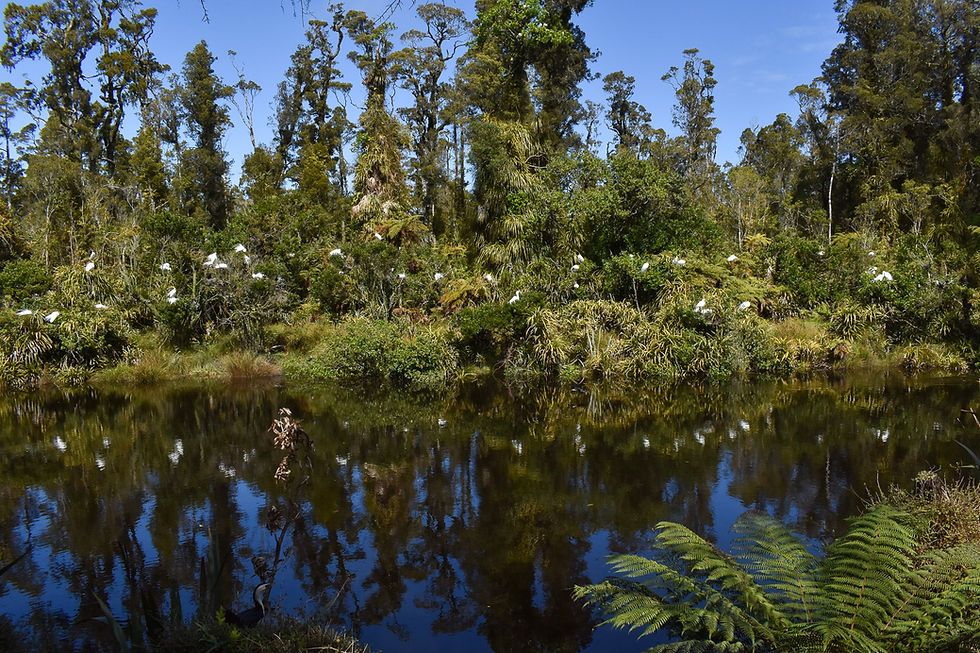
"While the men were at work yesterday, I took the best of the Mauri (sic) canoes and paddled up the Waitangi-Roto, the river which, according to the Native Commissioner Mr Mackay, runs out of the supposed lake. About six miles up, the river branched in many small arms, and my progress was put an end to by large trees lying across dense bush on both sides of the river, the beautiful kowhai trees abounding and almost all shrubs in flower, made this a real pleasure trip.
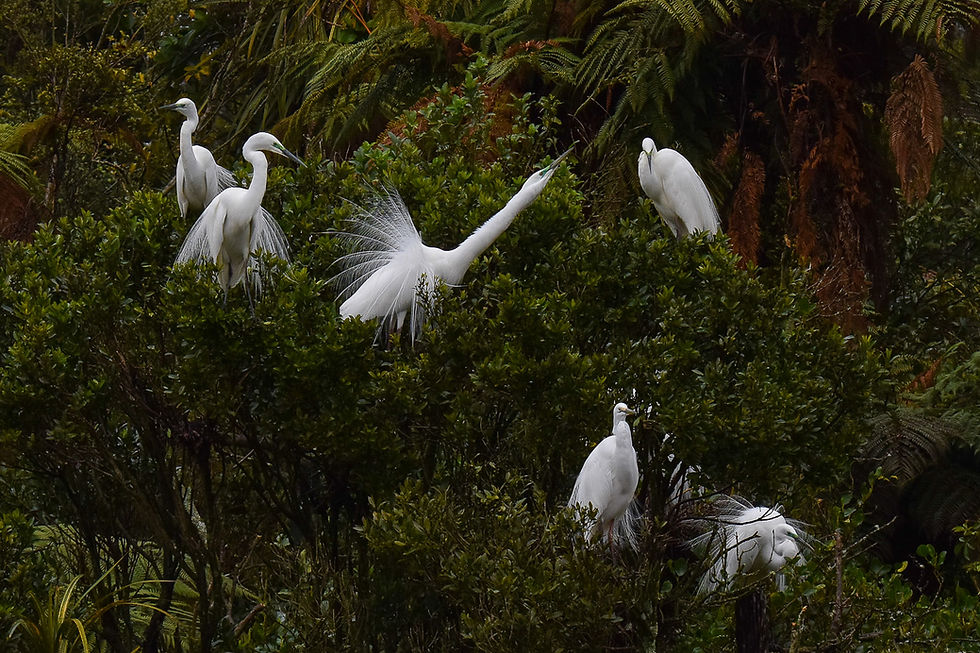
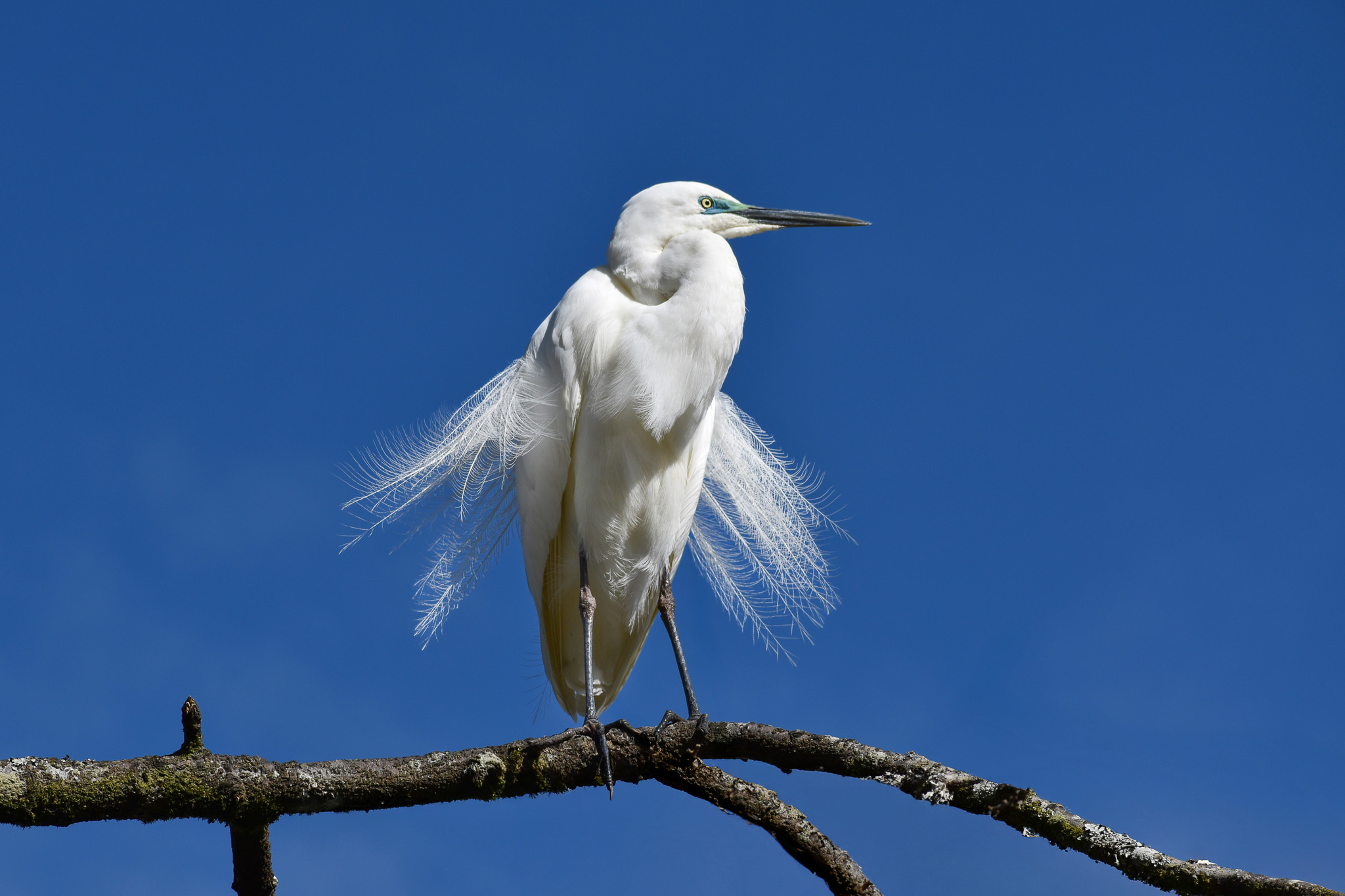
But the crowning beauty was a cranery which I discovered up the river, and that was a glorious sight. You remember the white cranes F. bought and I sent to Dr Kaup. Of these birds (near 4 ft high) imagine seeing around you from 50 to 60, sitting on high pines and lower trees, in a circle of about 150 yards, their pure white feathers shining in the sun. It was a glorious sight—I gave up pulling,and watched the tribe for a long time. They were not at all shy—kept up a continual 'plappering' among themselves and seemed to be astonished at me more than afraid.
When I returned in the afternoon and came to their 'village', I could not resist the temptation to have a look at their nes" (sic) all directions but the branches of the trees and the lower bushes were so well matted together by lawyers and other creeping plants, that I could not get a glimpse at a single nest and whilst I was crawling about underneath they remained sitting above, 'plappering' in the usual way. I am glad now that I had no gun with me—it would have been a pity to disturb this peaceful community. As for ducks, shags and such like, the river seems alive with them."
Historical Context and Notes
The letter quotes "white cranes" and "cranery" - At the time, White Herons were commonly referred to as "white cranes" by European settlers.
His reference to their "village" appears to describe the Kōtuku nesting site.

About Gerhard Mueller (1835–1918)
Gerhard Mueller was born in Darmstadt, Germany, on 7 February 1835.
He arrived in New Zealand in 1858 and trained as a surveyor under H. F. Giesow in Invercargill, where he married Elizabeth Bannatyne McArthur in 1862.
In 1865, he was contracted to survey Native Reserves on the West Coast, then part of Canterbury Province.
He was appointed Assistant Surveyor and Mining Surveyor for the Southern District of Westland in 1866.
Following his appointment as Chief Surveyor for Westland in 1871, Gerhard Mueller and his family moved to Hokitika.
In 1891, he transferred to Auckland as Commissioner of Crown Lands and later became Assistant Surveyor-General.
Gerhard Mueller died in 1918.
A Visit From Gerhard Mueller’s Great-Granddaughter
In December 2001, Gerhard Mueller's great-granddaughter, Bev Crombie, from Auckland, visited the Kōtuku colony. During her visit, she presented White Heron Sanctuary Tours with a copy of My Dear Bannie – Gerard Mueller's Letters from the West Coast 1865–6, which includes Gerhard Mueller's letters to his wife, Bannie, containing the first known written record of the Kōtuku colony.

The Kōtuku Colony Today
More than 160 years after Gerhard Mueller's remarkable discovery, the Waitangiroto Nature Reserve remains home to New Zealand's only Kōtuku (White Heron) breeding colony.
Access to this protected breeding site is carefully managed by the Department of Conservation (DOC), and White Heron Sanctuary Tours is the only operator permitted to take visitors to view the nesting colony.
With a population of only 150–200 birds, the Kōtuku is one of New Zealand's rarest native birds and is classified as Nationally Critical.
Our guided tours provide a unique opportunity to observe these magnificent birds in their natural breeding environment while supporting their ongoing conservation.

Join us to Experience the Magic of the Kōtuku
Learn more about the White Heron Sanctuary Tour and plan your visit to witness New Zealand's only Kōtuku breeding colony.